Abstract
Deep learning in de novo protein design has achieved atomic-level fidelity. However, existing models remain largely non-deliberative: they directly synthesize molecular geometries without explicitly reasoning about which residues or interactions are functionally essential. As a result, design decisions are entangled with continuous sampling dynamics, limiting interpretability, controllability, and systematic reuse of biochemical knowledge. We introduce Proteo-R1, a reasoning-guided protein design framework that explicitly decouples molecular understanding from geometric generation. Proteo-R1 adopts a dual-expert architecture in which a multimodal large language model (MLLM) serves as an understanding expert, analyzing protein sequences, structures, and textual context to identify key functional residues that govern binding and specificity. These residue-level decisions are then passed as hard constraints to a separate diffusion-based generation expert, which performs conditional co-design while respecting fixed interaction anchors. This factorization mirrors how human experts approach molecular engineering: first, reasoning about critical interactions, then optimizing geometry subject to those constraints. By operationalizing reasoning as explicit residue-level commitments rather than latent textual guidance, Proteo-R1 achieves stable, interpretable, and modular integration of LLM reasoning with state-of-the-art geometric generative models.
Method Overview
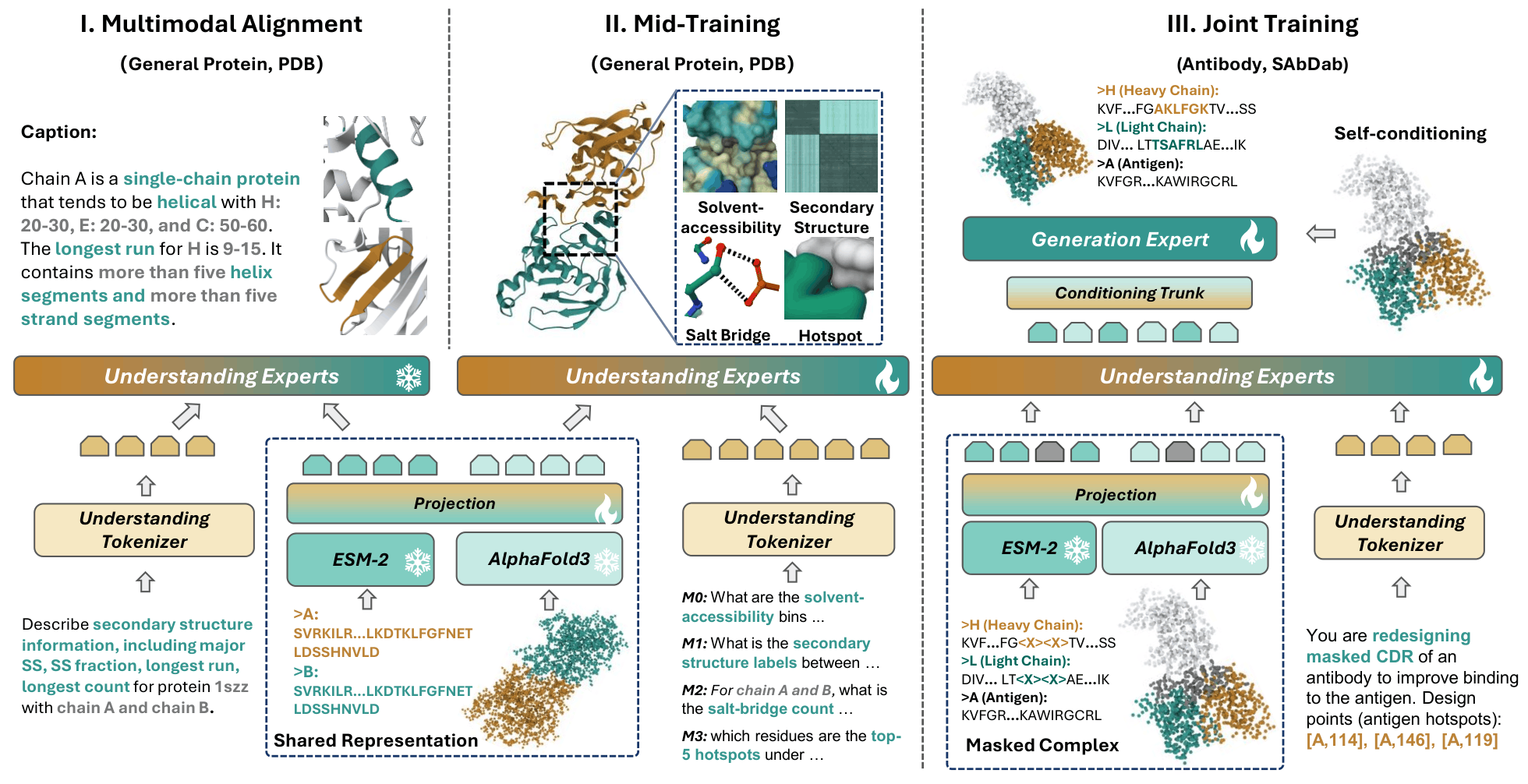
Proteo-R1 is a dual-expert framework that couples a multimodal reasoning expert with a diffusion-based generation expert. The reasoner identifies residue-level interaction anchors from sequence, structure, and instruction context, and the generator performs conditional co-design under these explicit biochemical constraints.
Key Results
- Reasoning and generation are explicitly decoupled via residue-level anchors.
- Reasoning-guided CDR co-design improves realism, controllability, and interpretability.
- The architecture is modular and can integrate with modern geometric generators.
Main Tables from Paper
Geometry-Centric Evaluation of Simultaneous Multi-CDR Redesign
| Method | H1 | H2 | H3 | L1 | L2 | L3 | Loop-RMSD | IMP | Clash_in | Clash_out | JSD_bb |
|---|---|---|---|---|---|---|---|---|---|---|---|
| DiffAb | 1.52 | 1.44 | 4.29 | 1.43 | 1.21 | 1.80 | 5.03 | 53.35 | -- | -- | -- |
| dyMEAN | 1.65 | 1.47 | 6.15 | 1.58 | 1.23 | 1.59 | 7.84 | 5.60 | -- | -- | -- |
| HTP | 1.56 | 1.45 | 4.32 | 1.55 | 1.20 | 1.73 | 7.18 | 6.09 | -- | -- | -- |
| IgGM | 1.73 | 1.55 | 4.37 | 1.62 | 1.51 | 1.71 | 9.18 | 9.01 | 25.63% | 1.45% | 0.2873 |
| AbX | 1.55 | 1.23 | 4.91 | 0.76 | 0.40 | 1.30 | 5.77 | 52.26 | 1.47% | 0.30% | 0.2497 |
| MFDesign | 1.61 | 1.44 | 3.71 | 1.65 | 1.15 | 1.69 | 4.28 | 59.16 | 0.53% | 0.26% | 0.2734 |
| Proteo-R1 | 1.33 | 1.13 | 3.81 | 1.54 | 0.85 | 1.51 | 4.51 | 56.58 | 0.50% | 0.14% | 0.2661 |
CDR-H3 Design on RAbD
| Model | AAR | lDDT | TMscore | RMSD | DockQ |
|---|---|---|---|---|---|
| RosettaAb* | 32.31% | 0.8272 | 0.9717 | 17.70 | 0.137 |
| DiffAb* | 35.31% | 0.8281 | 0.9695 | 23.24 | 0.158 |
| MEAN* | 37.38% | 0.8252 | 0.9688 | 17.30 | 0.162 |
| GeoAB* | 40.02% | 0.8367 | 0.9695 | 15.43 | 0.187 |
| HERN | 32.65% | --- | --- | 9.15 | 0.294 |
| dyMEAN | 41.84% | 0.8392 | 0.9718 | 8.10 | 0.407 |
| DGENet | 42.67% | 0.8551 | 0.9747 | 7.19 | 0.431 |
| BoltzGen | 39.07% | 0.8372 | 0.9675 | 2.69 | 0.473 |
| Proteo-R1 | 10.75% | 0.9693 | 0.9816 | 2.46 | 0.801 |
Sequence Recovery vs Inverse Folding Consistency
| CDR | AbX (AAR / IF-AAR / Delta) | IgGM (AAR / IF-AAR / Delta) | MFDesign (AAR / IF-AAR / Delta) | Proteo-R1 (AAR / IF-AAR / Delta) |
|---|---|---|---|---|
| H1 | 71.34 / 59.80 / -11.54 | 73.98 / 62.76 / -11.22 | 74.95 / 60.90 / -14.05 | 42.62 / 61.17 / +18.55 |
| H2 | 59.15 / 46.10 / -13.05 | 59.15 / 45.79 / -13.36 | 67.54 / 40.63 / -26.91 | 18.97 / 31.67 / +12.70 |
| H3 | 31.58 / 18.96 / -12.62 | 29.42 / 19.55 / -9.87 | 65.04 / 19.73 / -45.31 | 15.06 / 19.27 / +4.21 |
| L1 | 89.13 / 62.02 / -27.11 | 72.20 / 56.53 / -15.67 | 82.98 / 54.94 / -28.04 | 47.12 / 51.40 / +4.28 |
| L2 | 90.90 / 62.33 / -28.57 | 71.43 / 55.66 / -15.77 | 87.81 / 53.22 / -34.59 | 46.43 / 51.43 / +5.00 |
| L3 | 67.82 / 43.49 / -24.33 | 59.43 / 41.84 / -17.59 | 80.15 / 40.98 / -39.17 | 40.43 / 37.09 / -3.34 |
Compatibility with UniMoMo Backbone (CDR-H3)
| Model | #Gen | AAR | RMSD | IMP | Delta G |
|---|---|---|---|---|---|
| MEAN | 1 | 29.13% | 1.87 | 6.67% | -- |
| dyMEAN | 1 | 31.65% | 8.21 | 11.86% | -- |
| GeoAB-R | 1 | 32.04% | 1.67 | 6.67% | -- |
| UniMoMo (all) | 100 | 52.34% | 1.04 | 65.00% | 8.46 |
| Proteo-R1 (UniMoMo) | 100 | 48.94% | 0.83 | 67.79% | 7.35 |